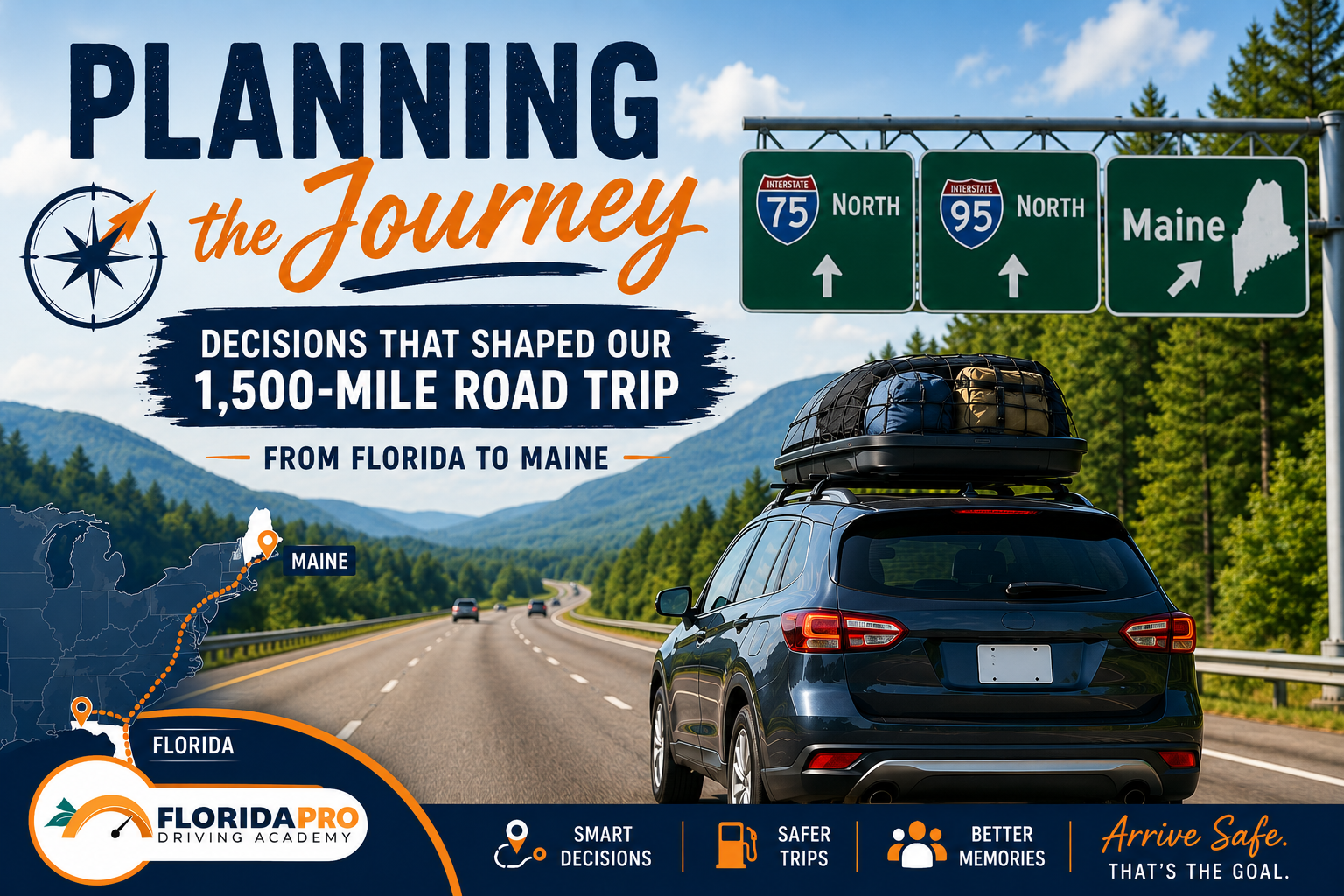
Planning the Journey: Decisions That Shaped Our 1,500-Mile Road Trip from Florida to Maine
After preparing our vehicle and discussing how to stay alert behind the wheel, the next challenge was deciding how to plan the trip itself. A GPS can usually get you from Point A to Point B, but the fastest route isn't always the safest—or the least stressful.
Years ago, planning a trip often meant spreading a paper map across the kitchen table and highlighting your route with a marker. Today we have GPS apps that can estimate arrival times, identify traffic delays, warn us about construction, locate fuel stops, and even provide turn-by-turn directions. These tools are incredibly helpful, but they should never become a distraction while driving.
For our trip from Tampa, Florida, to Maine, we quickly realized that planning a successful road trip involved far more than simply choosing which highway to take. Some of those decisions worked exactly as planned. Others taught us lessons we'll definitely remember on our next trip.
Decision #1: Choosing the Best Route
We knew we'd eventually be traveling north on Interstate 95, but the first question was how to get there.
One option was to take Interstate 4 toward Daytona Beach before connecting with I-95. If you've lived around Hillsborough County very long, you already know why we crossed that option off the list. Driving I-4 is often unpredictable and congested, so we decided to head north on I-75 instead.
Our route took us to Exit 358 near Ocala, then onto U.S. Route 301 before connecting with Interstate 10, Interstate 295, and finally Interstate 95 in Jacksonville.
Route 301 is a pleasant drive through several smaller Florida towns, but drivers should pay close attention to changing speed limits. If you're traveling after dark, be aware that lighting is limited in many areas.
Choosing this route helped us avoid one of the busiest interstate corridors in Central Florida before our trip had really begun.
Decision #2: Planning Fuel Stops
Because fuel prices were noticeably higher during our trip, we wanted to be strategic about where we filled up. Every dollar saved on fuel was another dollar we could spend enjoying the vacation.
Since we're members of Costco and Sam's Club, we planned many of our fuel stops around their locations. We also knew we had to stop at Buc-ee's.
For me, Buc-ee's can be a little overwhelming. My family, however, absolutely loves it.
I planned to stop only long enough to fuel up before continuing toward Savannah, Georgia, where I intended to take our first extended rest break while everyone else explored Buc-ee's at their leisure.
Instead, our first Buc-ee's stop turned into a 45-minute shopping adventure.
At the time, I found myself getting frustrated. Looking back, I realized the frustration wasn't caused by Buc-ee's at all. It happened because I had a plan in my head that no one else knew about.
My family thought we were stopping to enjoy Buc-ee's.
I thought we were stopping only for fuel.
Neither of us was wrong—we simply had different expectations.
That was a valuable lesson for me. Better communication before the trip would have eliminated much of that unnecessary frustration.
Decision #3: Deciding Who Would Drive
One unique part of this trip was that my teenage son, who currently has his learner's permit, would also be driving portions of the journey.
He already had considerable highway driving experience around the Tampa Bay area, so I felt this would be an excellent opportunity to expose him to longer interstate driving.
Like most parents of a new driver, I watched every mile carefully.
Long-distance driving presents different challenges than driving around town. Drivers experience changing traffic conditions, construction zones, fatigue, and long periods of concentration.
I was proud of how well he handled those situations. The experience gave both of us greater confidence for future road trips.
We continued taking breaks every two to three hours, giving both of us an opportunity to stretch, relax, and reset before continuing.
The only real sacrifice I made was listening to his music for several hours—although I did reserve the right to control the volume.
Decision #4: Sometimes Saving a Few Dollars Isn't Worth the Stress
Our next planned fuel stop was a Costco in Glen Allen, Virginia.
Unfortunately, this stop taught us another lesson.
While the fuel was less expensive, the station was much farther from the interstate than we expected. We lost valuable time navigating unfamiliar local roads and dealing with heavier traffic than anticipated.
To make matters even more interesting, we decided to share our location with family members who weren't traveling with us.
It seemed like a great idea.
Until they started questioning the route we were taking.
We quickly discovered that sharing your location can sometimes create a few extra "backseat drivers."
Looking back, the money we saved wasn't worth the additional stress. Sometimes the cheapest option isn't the best option.
Decision #5: Washington, D.C. or Around It?
One of the biggest decisions we faced was whether to drive directly through Washington, D.C., and New York City or attempt to bypass them.
Driving around both cities could reduce traffic and tolls, but it would also add mileage and travel time.
Driving through them offered the shortest route, but success depended entirely on traffic, crashes, and construction—things no one can accurately predict.
Based on our departure time and previous experience traveling this route, I decided to drive directly through both cities.
Fortunately, traffic was moderate. We encountered a few delays from crashes, but overall the decision worked well on this particular trip.
Would I make the same decision next time?
Maybe.
One thing long road trips teach you is that every trip is different. I would evaluate current traffic conditions again before making that decision.
Decision #6: Expect the Unexpected
Once we left New York City, we continued toward Hartford, Connecticut, using the Merritt Parkway.
If you've never driven it, the Merritt Parkway is a beautiful but challenging roadway. Much of it is two lanes, narrow, winding, and lined with hills and curves.
Since we were driving at night, traffic was fairly light.
That changed quickly.
Coming around one curve at approximately 45 mph, we suddenly found two vehicles completely stopped in our lane. We never determined exactly why they had stopped—possibly wildlife—but we had to brake hard to avoid a collision.
Later we encountered another disabled vehicle that required us to quickly move into the adjacent lane.
Both situations reinforced something I've taught for years—staying focused behind the wheel isn't just good advice; it may prevent a crash.
Had I been distracted by my phone, adjusting the navigation system, or simply not paying attention, the outcome could have been very different.
Final Thoughts
Our final fuel stop before reaching Maine was in Scarborough. The trip took approximately 42 hours, including several planned breaks.
Looking back, we realized that planning a road trip involves much more than simply choosing a route. Every decision—from fuel stops and departure times to who would drive and when—affected the overall experience.
We didn't make every decision perfectly, but every decision taught us something that will make our next trip a little safer, a little less stressful, and a lot more enjoyable.
Coming Next in Our Summer Road Trip Series
Looking Back on 3,000 Miles: What We'd Do the Same, What We'd Change, and Why We'd Take the Trip Again
Planning a Road Trip?
Whether you're driving across Florida or across the country, good planning helps make every trip safer.
At Florida Pro Driving Academy, we're committed to helping drivers make smart decisions before they ever turn the key. Explore more free traffic safety articles and driving tips at: https://floridaprodrivingacademy.com
Because arriving safely is always the goal.